Creating a SQL Datasource
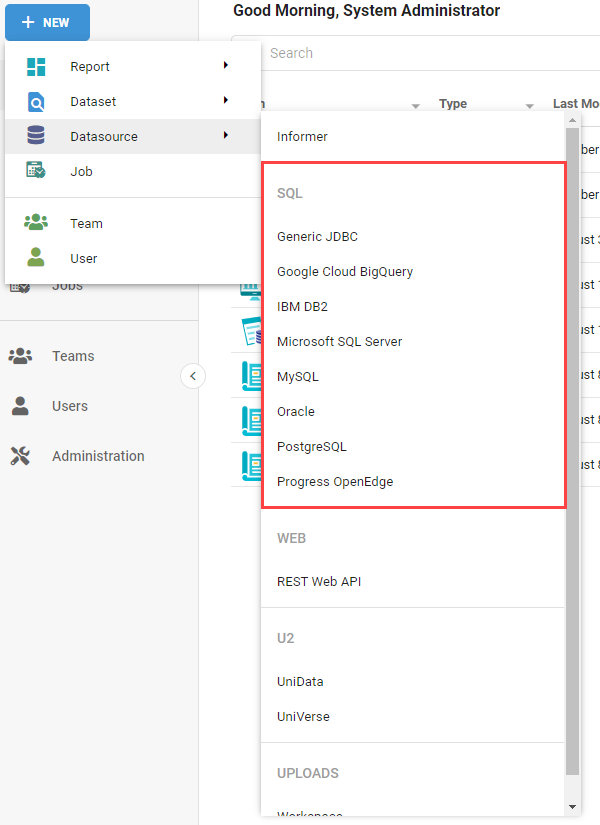
To connect Informer to a relational database, create a SQL Datasource. From the Datasource listing page, click New Datasource and choose a SQL database type.
Connecting
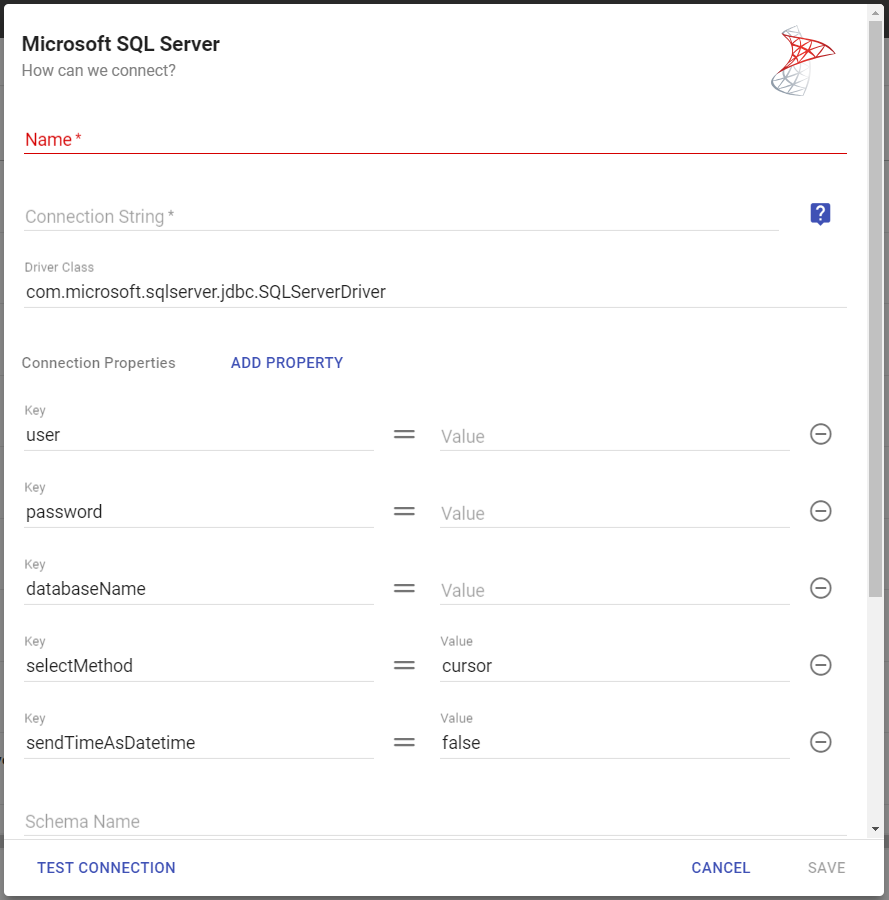
Select the database type, and a connection form appears with fields specific to that type. A Generic JDBC Datasource can connect to any database that has a compatible JDBC driver installed on the Informer server (see Installing JDBC drivers).
The common fields across SQL types are:
- Name: a name for the Datasource.
- Connection String: points to the database, including the connection type, server, and port, for example
jdbc:driver://localhost:1433. - Driver Class: the Java class for the JDBC driver. For SQL Server it defaults to
com.microsoft.sqlserver.jdbc.SQLServerDriver. - Connection Properties:
- user / password: the credentials to connect with.
- databaseName: the database name. This is case-sensitive; a non-matching case will not scan.
- selectMethod: mostly affects performance. The default,
cursor, is usually best. - sendTimeAsDateTime:
trueorfalse(defaults tofalse). - encrypt: set to
falseto disable TLS. For a Microsoft SQL Server Datasource, setencrypt = trueto enable encryption (it defaults tofalse). For a Generic JDBC Datasource connecting to SQL Server,encryptis not set tofalseby default, so the driver behaves as if it weretrue; setencrypt = falseexplicitly to disable encryption.
- Schema Name: the schema, if any. MySQL has no schema, so it defaults to the database name.
- Multiple Schemas: check this if there are several schemas, then use Add Schemas.
- Transaction Isolation Level: defaults to Read Uncommitted, so queried records are not locked.
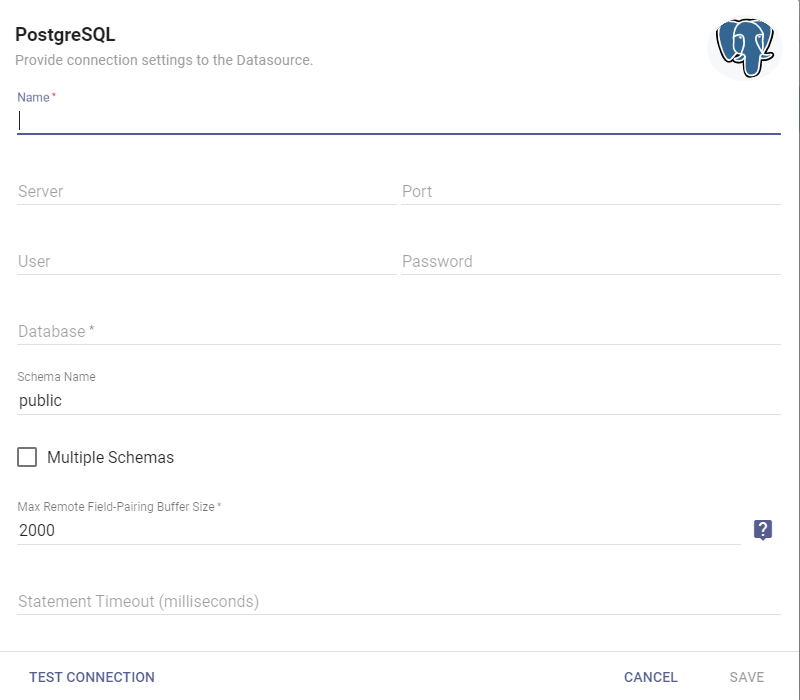
Other types, like PostgreSQL and MySQL, use a simpler form with Server, Port, User, Password, and Database fields.
Generic JDBC options
A Generic JDBC Datasource has a few unique fields:
- Connection String: the base connection string Informer uses, for example
jdbc:sqlserver://servername:1433. - Driver Class: the Java class for the JDBC driver (from the driver's documentation).
- Use Prepared Statements: enable or disable prepared statements (enabled by default).
- Connection Properties: Key/Value pairs appended to the connection string. Drivers typically need
username,password, anddatabaseName; some need more. Click Add Property for each pair.
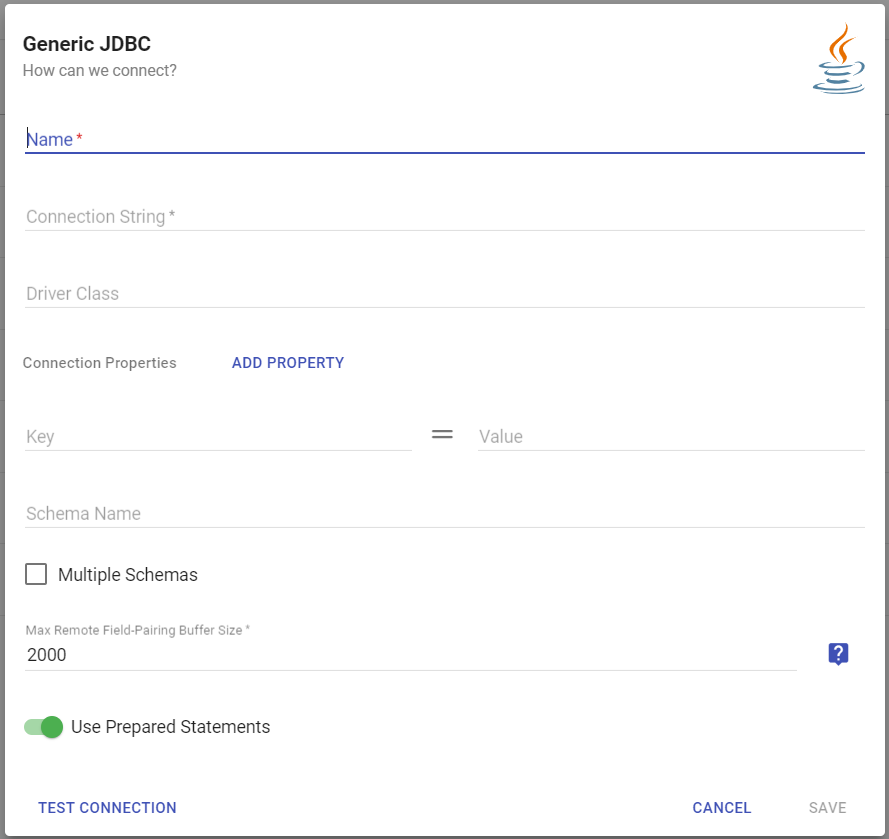
When connecting to Snowflake via Generic JDBC, add the connection property CLIENT_METADATA_REQUEST_USE_CONNECTION_CTX with a value of true. Without it, Snowflake searches your entire account for metadata during a scan instead of just the connected database, which can cause scan failures and slow performance.
After entering the details, click Test Connection to verify, then save. Then scan the Datasource to bring in its Mappings and Fields. See Scanning a Datasource.
For connection properties per database, see the vendor documentation: Microsoft SQL Server, Oracle, MySQL, PostgreSQL, IBM DB2, Progress OpenEdge, and Snowflake.
Google Cloud BigQuery
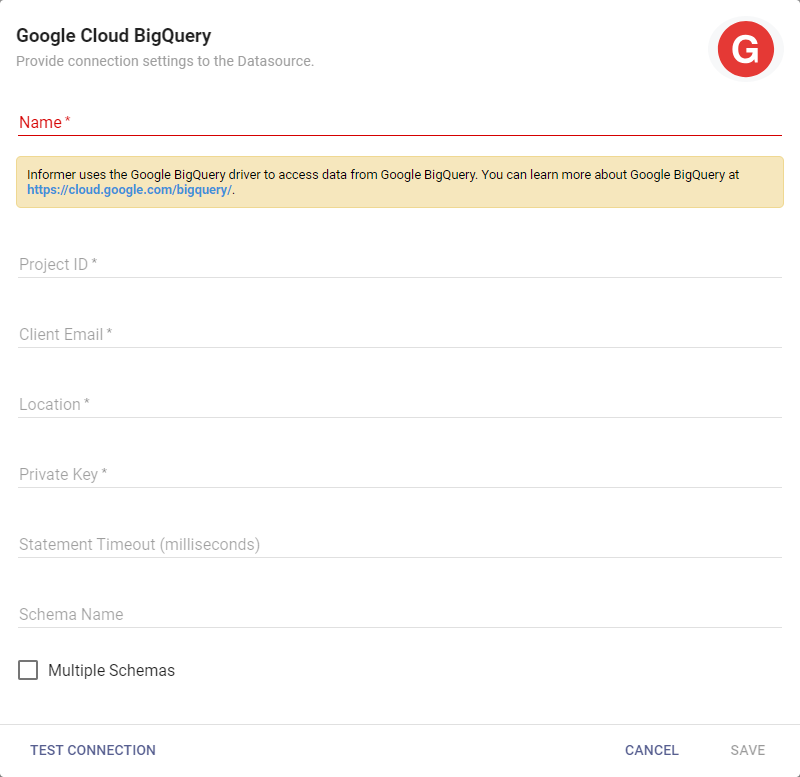
Google Cloud BigQuery is a serverless data warehouse, and connecting to it needs different information. First download a key as JSON from a Google Cloud service account, then open it in a text editor to get the values.
In Informer, click + New, select Datasource, then Google Cloud BigQuery. Give it a name, then copy the Project ID, Client Email, Location, and Private Key from the key file into the matching fields. Add any optional information (Schema Names, a Timeout), then click Save.