Creating and Editing Assistants
Assistants act like a chatbot with private access to your Informer data. Use them to have open-ended conversations with AI about data-related topics, often relating to the Datasets or files you add in the Knowledge section. An iterative process may be needed to teach the Assistant how best to answer questions.
Click the + New button in Informer, then click Assistant to create a new Assistant.
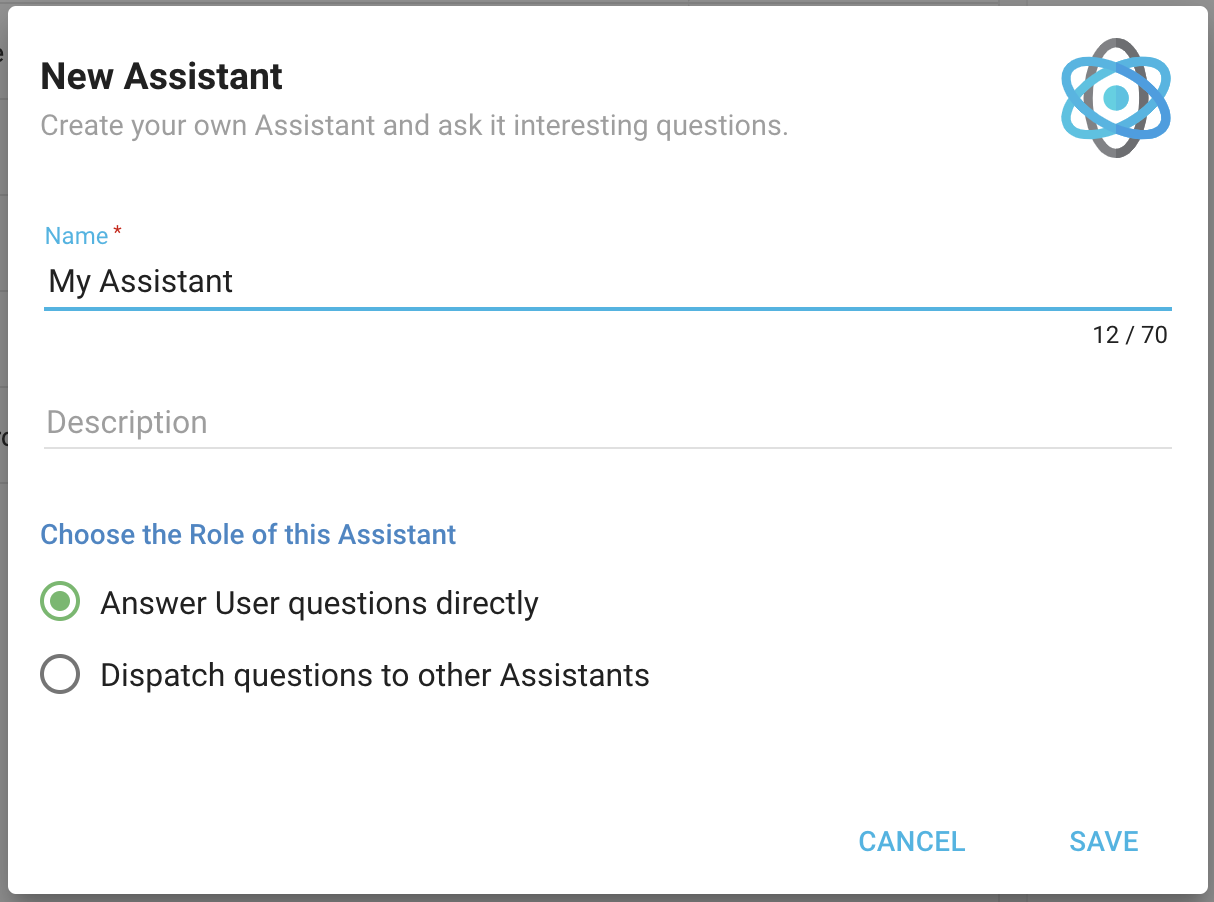
Enter a name, an optional description, and choose the Assistant's role:
- To create a typical Assistant that answers questions directly, choose Answer User questions directly.
- To create an Assistant that forwards questions to other Assistants, choose Dispatch questions to other Assistants.
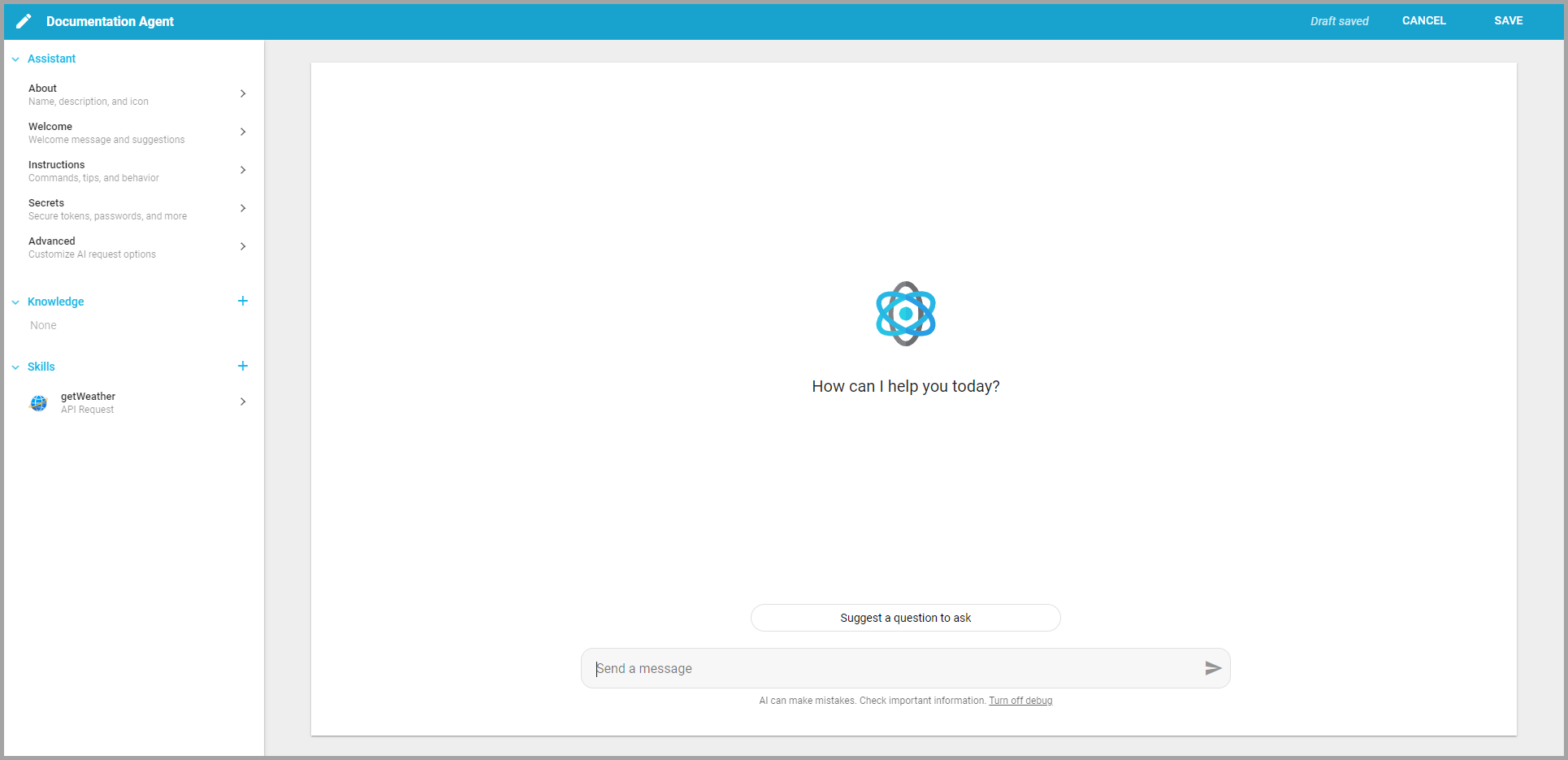
Click Save to open the editor. For a typical Assistant, the left panel has three sections.
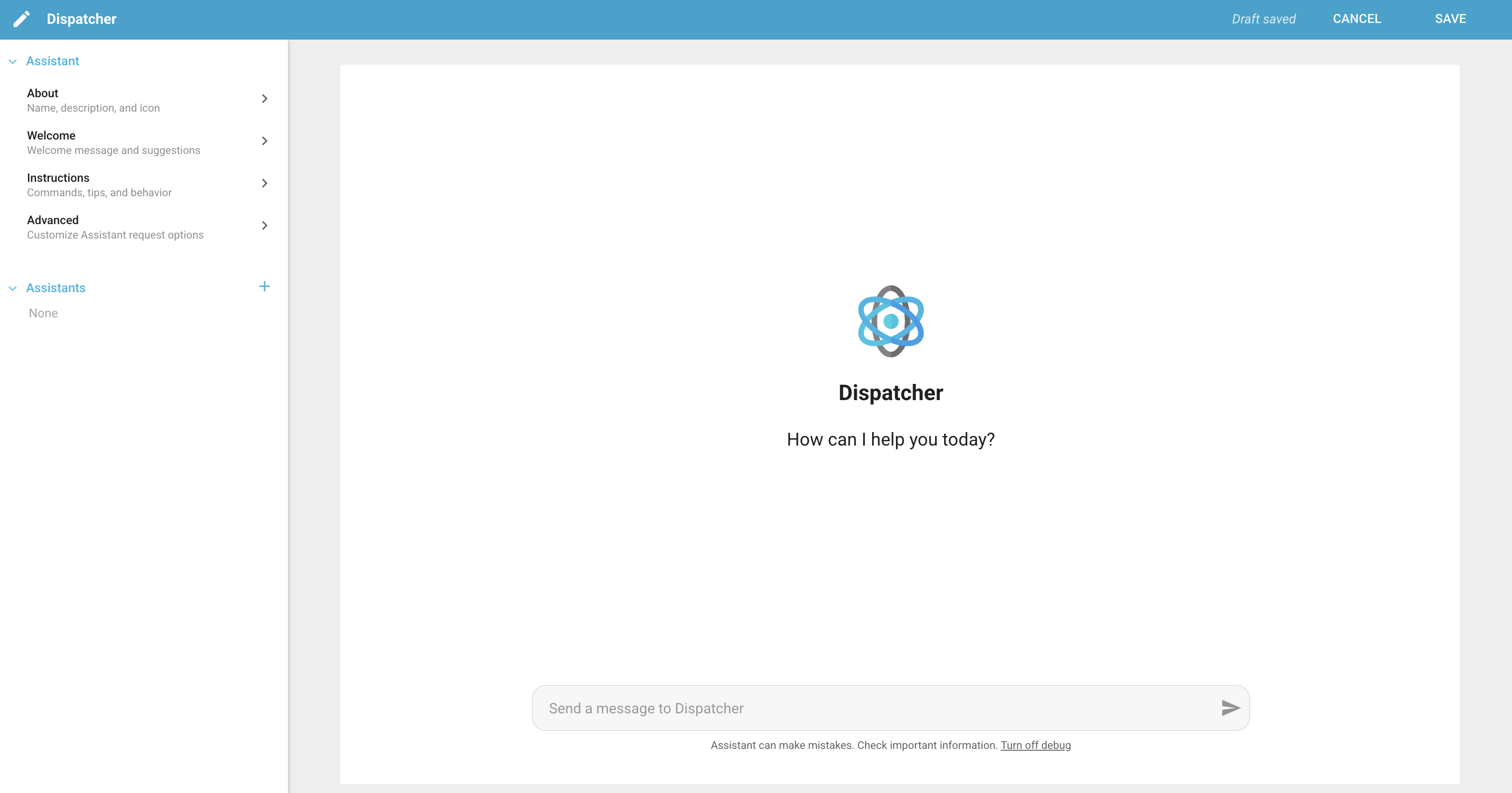
For a dispatch Assistant, the left panel has two sections, Assistant and Assistants (the other Assistants it forwards questions to).
Assistant
Customize the Assistant's information and how it interacts with Users.
- About: Name the Assistant, provide a short description, and choose an icon. The icon appears when the chat first opens, along with the welcome message.
- Welcome: Create a short welcome message and suggested prompts shown to Users when the Assistant launches. Users can click a suggested prompt to begin a conversation.
- Instructions: Guide the Assistant on how to respond, including behavior, tone, and content. Use instructions to correct the Assistant if it is not answering in the desired way. You can also define commands here for Assistant-specific actions, for example:
Commands: /pipeline {user}: Determine the pipeline for the given user and show the statuses in a table. - Secrets: Add secrets the Assistant uses to authenticate with external services. A secret securely saves credentials without hard-coding them into a request; they are encrypted and can only be used by the Assistant. Reference a secret in a Skill with
$secrets.mySecret. This is especially useful with the API Request Skill.- Key: A name for the secret to help the Assistant identify it.
- Value: The value (such as an API key). It is encrypted and cannot be viewed again, only replaced.
- Advanced: Choose the AI Model the Assistant uses to generate responses, from the models configured in Settings → Models.
Before 2026.1, the Advanced section offered a GPT Model picker plus Temperature, Seed, and Response Format fields. It now offers a single AI Model chooser tied to the models your administrator configures in Settings → Models.
Knowledge
Add data the Assistant can use and reference. Click the + next to Knowledge to add a Dataset or an uploaded file.
- Add Dataset: Select a Dataset. The same field- and row-level security that applies to the User applies to the Assistant.
- Upload File: Upload files the Assistant can analyze. Use the Description to add instructions for how the Assistant should use the data, and the File Viewer tab to examine the file.
Skills
Skills are extra capabilities you add to an Assistant to perform specific functions.
- API Request: Make an API call and return the response. Use
$params.namefor anything the Assistant needs to provide, and$secrets.namefor secrets. A Post Script can manipulate the response before the Assistant receives it. - Highcharts: Dynamically create Highchart Visuals that may not exist inside Informer.
- Print Template: Call an Informer Template. Use the Assistant Parameters tab for the Template parameters the Assistant needs to understand.
- Simple Function: Create a function the Assistant can use to answer questions or perform tasks.
See Skills for full detail on each Skill.