Installing an App
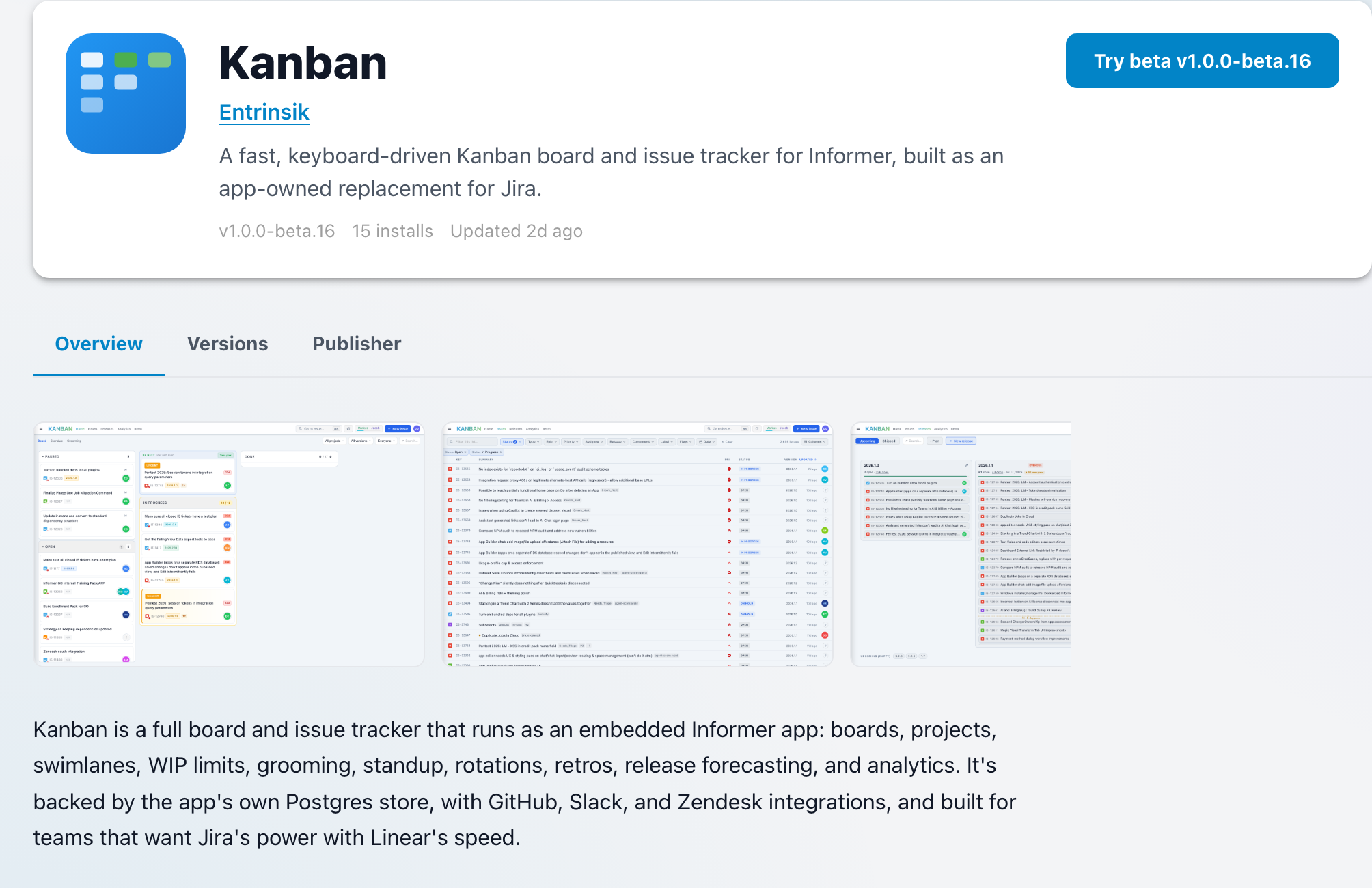
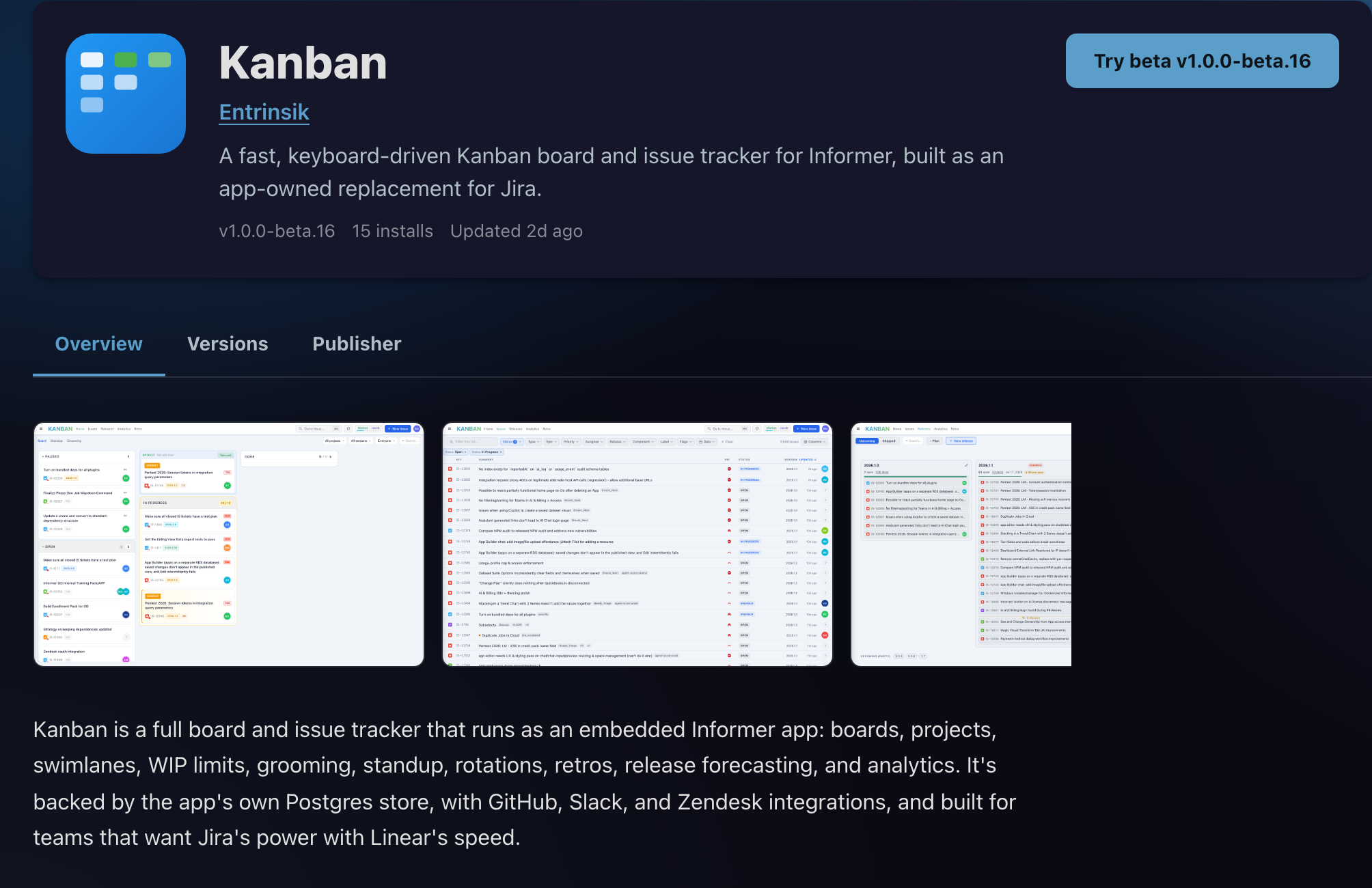
Selecting a pack opens its listing: what the App does, who publishes it, which versions exist, and one button that installs it. Installing creates a normal App in your gallery, with a link back to the listing it came from.
Why it exists
An installed pack is not a copy you now own and maintain. It stays attached to its publisher, which is what makes updates possible later: the publisher ships v1.4.0 and your install offers to move to it, keeping the data the App has collected in the meantime. The listing page is where that relationship starts, so it front-loads the things worth knowing before you commit.
Reading the listing
Across the top sit the facts you would want before installing anything:
- Installed v1.2.0 when you already have it, so the page never leaves you guessing.
- Verified publisher where Entrinsik has confirmed who the publisher is.
- An install count and Updated 3 days ago, the two cheapest signals of whether a pack is alive.
- Requires Informer ≥ 2026.1.0 when the pack needs a newer Informer than some instances run.
Below that, tabs split the detail up:
| Tab | What's in it |
|---|---|
| Overview | What the App does, and its screenshots. |
| Versions | Every published version with its release notes. |
| Publisher | Who made it, their other Apps, support and website links. |
Feedback is not one of them. It runs through the installed App instead, see Feedback and support.
A fourth tab, Integrate, appears only on versions that publish a public API, so most listings show the three above. Where it is present it is worth knowing about even if you never open it: the pack's API is documented and frozen per version, and the tab hands you a ready-made prompt for the App Builder or Claude Code to build against it.
Versions and channels
A publisher can ship two lines of the same App at once: stable, the one meant for real work, and beta, a pre-release. When both exist, a channel toggle appears and the listing's buttons follow whichever channel you have selected. Stable reads Stable · v1.4.0; the beta face shows its own version.
The two are separate installs, not two states of one. Installing the beta does not disturb the stable App you are already running, which is what the uninstall dialog means when it says "Your stable install, if any, is untouched." You can hold both at once and they appear as two Apps in your gallery.
What the beta starts with depends on whether you already run the stable one:
- With a stable install, the beta seeds from it. Informer clones that App's workspace, its schema, its data, and its migration history, so the beta opens on real data and applies only the migrations the beta version adds on top.
- Without one, the beta starts empty.
That is why the install dialog describes a beta as one that "clones your production data into a beta sandbox". It is a copy taken at install time, not a live mirror: work done in the beta afterwards stays in the beta, and work done in production afterwards does not appear there.
Requirements
A pack can declare a minimum Informer version, shown as Requires Informer ≥ 2026.1.0. It can also declare that it works with another pack, listed under Works with on the listing.
A dependency there tells you where you stand at a glance:
- REQUIRED on a dependency the App cannot run without.
- v2.1.0 installed when you already satisfy it.
- v1.0.0 installed, needs ^2.0.0 when the version you have is too old.
- Get from Marketplace when you don't have it yet.
- Not available in this marketplace when the dependency isn't published where your instance looks, which is the one case you cannot resolve yourself.
What installing does
Choosing Install v1.4.0 opens a progress dialog and works through four steps: downloading the pack, installing files, deploying, and finalizing. Deploying is the step that does the real work, running the App's migrations and wiring up its routes against its own workspace.
When it lands, the dialog reports "Install complete" and points at where the App now lives: "Order Desk is now in your Apps."
An update follows the same path. Because the App keeps its workspace across an update, only the migrations the new version introduces are applied, so the data the App has collected survives the move.
Troubleshooting
- Install failed. The dialog reports "Install failed" and offers Try again. Retrying is safe: a half-finished install reuses the App it already created rather than leaving a duplicate behind, and a beta whose data clone was interrupted re-seeds instead of deploying onto a partial copy.
- The install button is unavailable and the listing mentions a required Informer version. The pack needs a newer Informer than this instance runs. Upgrading Informer is an administrator task.
- A dependency reads "Not available in this marketplace". The App depends on a pack that is not published where your instance points. Ask the publisher which marketplace carries it.
- The App installed but the version badge is missing. That is the symptom of an App that has lost its link to its listing. See Updates and uninstalling.
Related: Updates and uninstalling for the rest of the App's life, and Apps for working with it once it is installed.